
Maryland Heights is a mid-sized Missouri community west of Saint Louis, where established subdivisions sit beside commercial corridors near the Missouri River bottoms. Properties range from post-war ranch homes with mature oaks and maples to newer mixed-use developments along Page Avenue and Dorsett Road. Thick canopy cover, shallow clay soil, and seasonal flooding create ongoing concerns for tree health and site access. Tree care professionals in Saint Louis know how to evaluate structural hazards in older hardwoods, handle root conflicts near utilities, and clear storm damage so properties stay safe and usable in every season.
That is why more property owners in Maryland Heights, MO, rely on Arbor Tree Care for year-round maintenance.

Prefer to Talk to An Expert?
(314) 254-9299
Why Maryland Heights Property Owners Count on Local Experts
Because they work in the area every day, these professionals understand the clay-rich soil, dense hardwood coverage, and floodplain exposure that shape tree care in Maryland Heights. Each job is matched with the right equipment and method for the property, whether the concern is storm damage, root movement, or fungal disease common in this part of Saint Louis.
From professional stump removal solutions near the wooded lots along Fee Fee Road to careful canopy thinning on the commercial edges of Dorsett Road, every project is completed with precision and a focus on long-term site function.
If you care about the condition of your property, trust local contractors to help keep your landscape healthy, stable, and safe in Maryland Heights.
Our Tree-Service Services
in Saint Louis, MO, Include
Tree Service Coverage That Matches Your Maryland Heights Neighborhood
The mix of lot sizes and access conditions in this area calls for tree services that are tailored, not generic. Local professionals use a property-specific approach for both residential and commercial sites.
Whether the work is on a mature ranch home in Westport Estates, a newer townhome community near Dorsett Road, or a business property by the Maryland Heights Expressway, the service plan is adapted to the location.
From reliable tree disease treatments and canopy pruning to stump removal and emergency storm cleanup, the work is designed around neighborhood conditions and each property’s needs.
Maryland Heights’s Aging Urban Forest and the Conditions That Shape It
Maryland Heights grew steadily during Saint Louis County’s westward expansion in the mid-twentieth century, with housing and development spreading around the Missouri River bottomlands and the Creve Coeur Lake corridor. That history still shows up today in compacted soil, older hardwood stress, and drainage-driven root instability that affect how tree work must be handled in the area.
Mature Oak and Maple Stress in Established Subdivisions
Many properties in Maryland Heights, especially older neighborhoods near Fee Fee Road and Westport, still have large oaks and silver maples that are at or beyond structural maturity. As crowns weaken and branch attachments decline, the risk of failure rises during Missouri’s spring storm season.
Local professionals address that decline with targeted crown reduction, deadwood removal, and cable bracing when needed to reduce damage and improve access over time.
Shallow Root Systems and Clay Soil Displacement
Clay-heavy soil can help hold moisture during dry periods, but it also contributes to root heaving near sidewalks, driveways, and foundations. In Maryland Heights, shallow lateral roots often push into pavement and can weaken hardscape edges over time.
Crews manage these issues with root barrier installation, careful excavation, and selective root pruning based on the surrounding hardscape and utility layout.
Fungal Disease Pressure from Missouri River Humidity
The humid conditions tied to the Missouri River bottoms make it harder for many Maryland Heights trees to resist fungal problems, especially anthracnose and oak wilt, which spread quickly in dense canopy settings.
Trusted professionals respond with targeted fungicide applications, removal of infected limbs, and selective thinning to improve airflow and support long-term tree health.
Storm Exposure and Wind Damage Along Open Corridors
Severe spring and summer storms in Missouri can bring straight-line winds and occasional tornado-producing systems, leading to limb failure or entire trees uprooting on Maryland Heights properties, especially in open southern exposures.
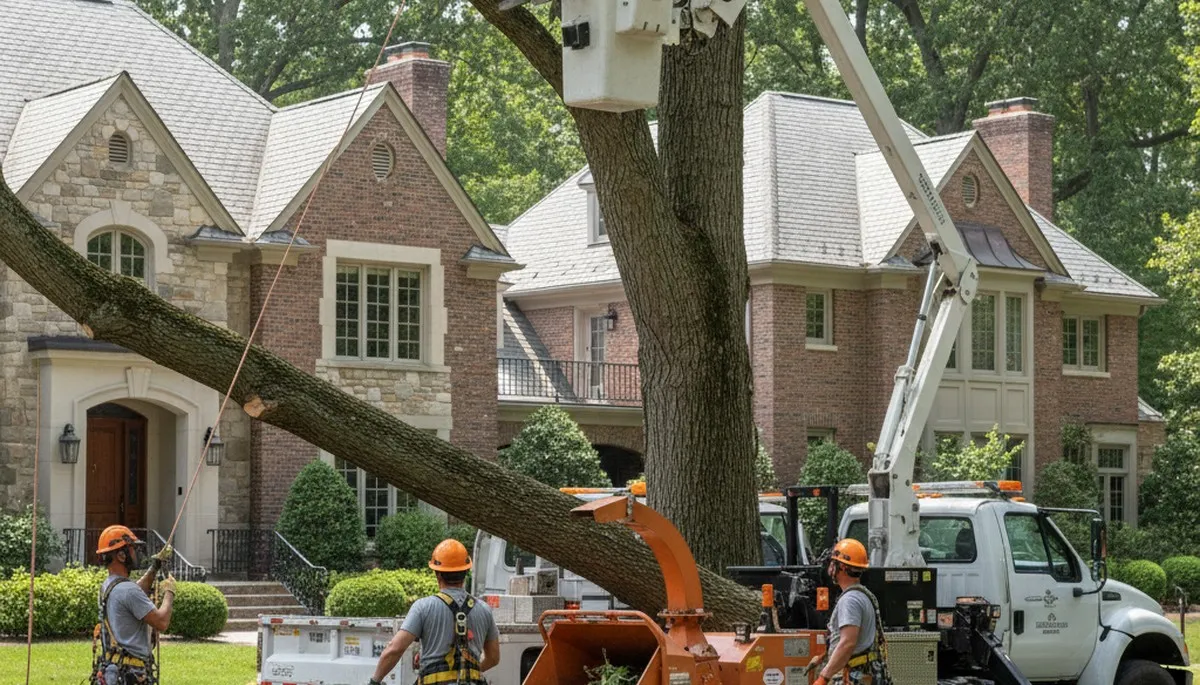
Experienced crews use emergency response methods such as aerial lifts, sectional felling, and debris removal systems to reopen driveways and restore access after storms.
Utility Line Conflicts in Dense Residential Blocks
Overhead utilities are common in Maryland Heights, which makes directional pruning and controlled removals more complex without specialized equipment and coordination with utility providers.
Local pros rely on compact aerial equipment and hand-climbing methods to maintain clearance and protect property while completing tree work without unnecessary interruption.

Kick off your tree service project today!

Tree Services in Maryland Heights, MO: Seasonal Care for Every Property
From routine pruning to urgent storm cleanup, here is how local crews help keep properties healthy, accessible, and structurally sound:
Routine Tree Trimming and Pruning in Maryland Heights, MO
- Canopy thinning for mature oaks along Fee Fee Road: Reducing dense crowns improves airflow and helps limit fungal pressure in neighborhoods with heavy overhead cover.
- Structural pruning for silver maples near Dorsett Road: Correcting weak branch unions and co-dominant stems before storm season lowers the chance of sudden limb failure on residential lots.
- Clearance trimming near utility lines in Westport-area subdivisions: Keeping branches safely separated from overhead infrastructure helps prevent outages and reduces risk for property owners.
- Seasonal shape maintenance for ornamental trees near Creve Coeur Lake: Proper pruning supports healthy bloom cycles and helps prevent overcrowding in mixed residential landscapes.
- Deadwood removal across established Maryland Heights neighborhoods: Removing dead and failing branches from mature hardwoods helps eliminate hazards before Missouri’s active spring storm season.
Schedule routine trimming before spring storms arrive to help protect your Maryland Heights canopy and reduce emergency risk.
Tree Removal Services in Maryland Heights, MO
- Hazardous tree removal near residential structures: Dead or unstable trees close to homes in older subdivisions are evaluated and removed with controlled sectional methods to protect nearby structures.
- Storm-damaged tree removal after severe weather events: High winds and ice loading in Missouri winters often leave trees partially damaged and in need of prompt removal to restore safe access.
- Dead tree removal from flood-affected lots near the Missouri River corridor: Trees weakened by repeated flooding can develop root rot and internal decay, making them priorities for removal before they fail.
- Commercial property tree removal along Page Avenue: Larger removals on commercial corridors require coordinated equipment placement and traffic control, both of which local crews can manage efficiently.
- Overgrown tree removal near driveways and access roads: Trees that interfere with vehicle entry on Maryland Heights properties are removed to restore practical and safe access. Similar challenges are addressed for tree removal contractors in Bridgeton, MO across the county line.
Removing hazardous trees quickly helps protect structures, utility lines, and pedestrian areas through every season in Maryland Heights.
Stump Grinding and Cleanup in Maryland Heights, MO
- Stump grinding following oak removal in established subdivisions: Large oak stumps left behind can create trip hazards and attract wood-boring insects if they are not addressed across Maryland Heights residential lots.
- Below-grade grinding near driveways and sidewalks: Stumps beside hardscape features require precise grinding depth so future root decay does not undermine pavement edges.
- Multi-stump cleanup on larger residential properties: Properties with several older stumps from past tree work benefit from grouped grinding that restores usable lawn space efficiently.
- Post-removal site cleanup and debris hauling: Full debris removal after stump grinding leaves properties ready for lawn restoration, replanting, or hardscape work without leftover wood chip piles.
- Stump removal near foundation edges and retaining walls: Decaying stumps close to structural features can lead to subsidence concerns, which grinding and root extraction help reduce. Crews serving Maryland Heights also handle stump grinding in Hazelwood, MO with the same careful approach.
Grinding stumps soon after removal helps prevent pests, removes trip hazards, and prepares Maryland Heights properties for the next phase of landscape improvements.
Emergency Tree Services in Maryland Heights, MO
- 24-hour storm response for fallen trees blocking driveways and structures: Missouri’s severe weather season often calls for fast action, and local crews respond across Maryland Heights to clear access and secure damaged trees.
- Fallen limb removal after wind events along residential corridors: Large limbs brought down by straight-line winds or thunderstorms are cleared from roofs, vehicles, and walkways with minimal disturbance to surrounding property.
- Emergency hazard assessment following ice storms: Ice can load branches beyond their limits, and post-storm inspections help determine which trees need immediate removal and which can be stabilized through pruning.
- Rapid response for utility-adjacent tree failures: Trees that fall toward or onto overhead lines require coordinated emergency removal with careful attention to live line hazards and public safety.
- Post-flood tree stability evaluation near the Missouri River bottomlands: Trees weakened by saturated soil after flooding are checked for structural integrity before they create a new hazard for nearby buildings or access routes.
Emergency crews familiar with Maryland Heights roadways and access conditions can reach affected sites quickly and work efficiently when urgent tree removal is needed.